Reading the Wood

James Carter
| 18-05-2026
 · Art Team
There's a moment in wood carving when the piece stops looking like carved wood and starts looking like fur, bark, cloth, or skin.
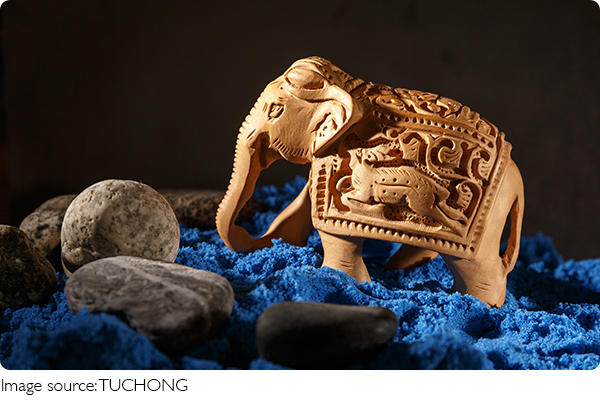
That moment comes from texture. Shape establishes form; texture makes it believable. It also makes it interesting — the interplay of rough and smooth surfaces creates the visual contrast that draws the eye across a piece and keeps it there.
Grain Is Not Your Enemy
Every cut in wood happens in dialogue with the grain. Working with the grain produces clean, smooth slices that hold detail beautifully. Working against it tears and splinters, leaving ragged surfaces that are difficult to resolve. Before any serious texture work begins, spend time studying the grain direction in your specific piece — particularly around knots or areas where the grain reverses. In those zones, adjust your tool angle and direction. The grain is not a constraint; it's information. Hardwoods like oak and walnut hold deeper, sharper detail than softwoods but require keener tools and more force. Basswood and butternut, both softer, are ideal for intricate texture work where light touch and fine detail are the priority.
V-Gouges for Lines and Definition
The V-gouge, or parting tool, is the primary instrument for linear texture. Fine V-gouges cut clean, sharp lines that simulate woodgrain, fur, feathers, hair, and etched surface patterns. A series of closely spaced parallel lines running in the direction of an animal's coat, for instance, reads immediately as fur when viewed at any distance. Vary the depth and spacing: deeper cuts create shadow and emphasis; lighter cuts recede. The direction of each cut matters — curves that follow the contour of a form reinforce its three-dimensionality, while lines that ignore the underlying form feel decorative rather than integral.
U-Gouges for Flow and Volume
Where V-gouges create definition and separation, U-gouges — whether tight or sweeping in profile — produce rounded, scooped marks that suggest softness, flow, and depth. Shallow U-gouge marks dragged across bark create the visual texture of weathered wood; deeper scooped grooves across a fabric fold suggest the weight of cloth. The size of the gouge determines the scale of the texture: large U-gouges for broad, expressive surface movement; small ones for fine, detailed surface work.
Stippling and Punch Work
For non-linear textures — rough stone, aged skin, porous surfaces, matted fur — stippling with a punch or nail set creates a field of small indentations that catch light and shadow in a way no straight line can. The density and depth of stippling controls the perceived roughness of the surface. Dense, deep stippling reads as coarse; light, sparse marks suggest something finer. Pneumatic tools with specialized bits dramatically expand the range of stippling effects possible, particularly on harder woods where hand stippling would be exhausting.
Plan Texture Contrasts Before You Cut
The most expressive wood carvings use texture not uniformly but strategically. Identify areas in your design where smooth and rough surfaces should meet — the contrast between them does more visual work than either surface alone. A polished face against roughly textured hair. A smooth stone vessel against a bark-covered branch. Those transitions focus attention and give the eye a reason to move through the piece. Test finishes on a sample area before committing: oil finishes deepen the grain and enrich dark woods; wax gives a soft sheen; varnish is generally avoided for its glassy surface that obscures rather than enhances carved texture.
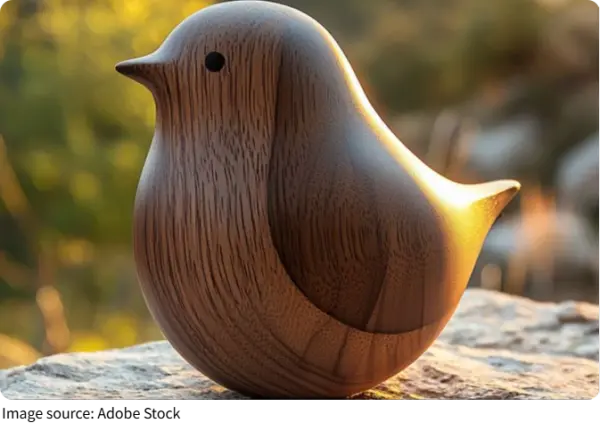
Texture is where carving becomes personal. Two carvers working from the same reference can produce pieces that feel entirely different — one restrained and polished, one raw and gestural — based entirely on how they choose to read and respond to the grain.