Ducks: Surprising Facts

Caleb Ryan
| 13-04-2026
 · Animal Team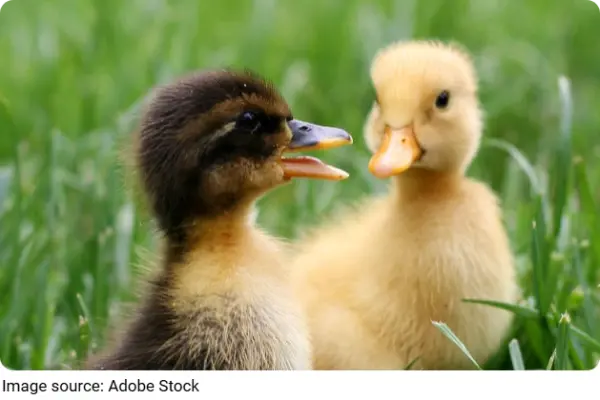
You have walked past them a hundred times — bobbing on a pond, waddling across a park path, tipping upside-down in shallow water with perfect comic timing.
Ducks are so familiar, so cheerfully ordinary, that most people have never stopped to ask a single question about them.
That is a significant oversight. Because once you start looking at what a duck actually is and what it actually does, the ordinary disappears entirely.
Those Feet Are an Engineering Masterpiece
A duck standing barefoot on winter ice is doing something that should, by rights, cause severe tissue damage. Water birds that wade in near-freezing water or stand on frozen surfaces for extended periods are managing a thermal challenge that would disable most animals within minutes. Ducks solve this through a circulatory system in their legs called countercurrent heat exchange.
Warm arterial blood traveling down from the body core passes alongside cold venous blood returning from the feet. The two blood streams run in opposite directions in close proximity, allowing heat to transfer from the outgoing warm blood to the incoming cold blood before it reaches the body core. The feet are therefore maintained at a temperature just above freezing — cold enough to minimize heat loss to ice or water, warm enough to prevent tissue damage. The duck's core temperature remains completely unaffected. It is a biological heat exchanger of remarkable efficiency, and engineers have directly studied it as a model for industrial thermal management systems.
Waterproofing That Never Fails
Duck feathers repel water so effectively that a duck emerging from a dive appears almost instantly dry. This is not simply a property of the feathers themselves — it is actively maintained through a daily process. Ducks spend considerable time each day preening, during which they distribute oil from the uropygial gland located at the base of the tail across every feather surface. This oil creates a hydrophobic coating that causes water to bead and roll off rather than soak through.
The structure of the feathers themselves adds another layer of protection:
1. Outer contour feathers overlap like roof tiles, directing water away from the body 2. Dense down feathers beneath trap a layer of warm air directly against the skin 3. The barbules of each feather interlock with microscopic hooks that zip the feather surface shut after disturbance 4. Regular preening re-zips any separated barbules, maintaining the waterproof surface continuously
A duck's skin almost never makes direct contact with water, even during extended diving. The insulating air layer beneath the feathers remains dry regardless of how long the bird spends submerged.
The Eyes See What Ours Cannot
A duck's eyes are positioned on the sides of its head, giving it a visual field of nearly 340 degrees — it can see almost everything around it simultaneously without moving its head. But the more remarkable feature is what ducks can see that humans cannot. Duck eyes contain four types of color receptors compared to the human eye's three, giving them tetrachromatic vision. This means they perceive colors in the ultraviolet spectrum entirely invisible to us.
In practice, this means:
1. Male duck plumage contains ultraviolet-reflective patterns used in courtship displays that are completely invisible to human observers 2. Ducks can detect water surfaces from great distances by the UV signature of reflected light 3. Food sources, predators, and environmental features all contain UV information that ducks process as part of their normal visual experience 4. What we see when we look at a mallard and what a duck sees when it looks at another mallard are genuinely different images
Sleep With One Eye Literally Open
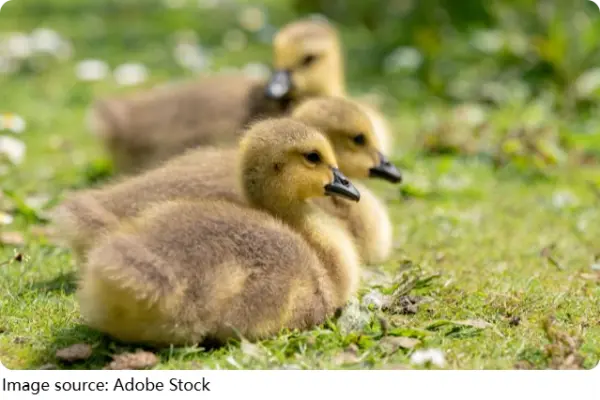
Ducks practice a form of sleep called unihemispheric slow-wave sleep — the ability to sleep with one half of the brain at a time while the other half remains alert. The eye connected to the sleeping brain hemisphere closes; the eye connected to the awake hemisphere remains open and functional. A duck resting in a row with others will position itself at the end of the group, keeping its outward-facing eye open to monitor for threats while sleeping on the exposed side.
Researchers have demonstrated that ducks increase the proportion of one-eyed sleep when they perceive higher risk in their environment, and decrease it when they feel secure. The system is essentially a biological security switch that the duck adjusts in real time based on perceived threat level.
Ducklings Imprint With Precision and Speed
The phenomenon of imprinting — where a newly hatched duckling forms an immediate and lasting attachment to the first moving object it sees — is one of the most studied behaviors in animal development. What is less widely known is how precise and time-limited this process is. The imprinting window opens approximately 13–16 hours after hatching and closes within 24–30 hours. Within that window, the duckling's brain is in a uniquely receptive state, forming permanent neural connections to whatever moving figure it encounters.
This is not simple recognition. Imprinting shapes the duckling's understanding of its own species identity, influencing its social preferences, mating behavior, and group belonging for its entire life. A duckling that imprints on a human will, as a mature bird, continue to treat humans as its primary social reference — demonstrating that the brain's earliest experiences are not merely memories but architectural decisions.
The duck at the park has not changed. But perhaps the way you see it has. There is something quietly humbling about discovering that an animal you passed without a second thought operates with biological systems more sophisticated than most technology humans have ever built. Nature rarely announces its most impressive achievements. It simply gets on with them, one ordinary-looking pond bird at a time. Next time you see a duck, look a little longer — it is almost certainly looking back at you with more information than you realize.